Thursday, April 16, 2020
Week 11- Sitka school district
In my research, I found there are many ways that technology can be used to help students learn better. One of these ways is student-directed learning. This is the idea that when students are in charge of their own education and use of technology as part of their learning they greatly increase their learning and retention of material. According to the Learning and Technology Policy Framework, when students are in charge of their learning and communicated and give feedback to their peers their learning rate can double (The Learning and Technology Policy, 2013).
As I am not currently teaching in a public school I had to look up the policies for the Sitka School District. According to SitkaSchools.org the goal of the district's technology equipment plan is to "provide a consistent, appropriate level of technology equipment for both students and staff to achieve the highest possible level of education with the available resources. Most of these policies have to do with ensuring the technology in the district is up to date and is maintained. It outlines the technology in each classroom and dictates the staffing of IT personnel to maintain the technology in each building.
When I looked at the policy the Sitka School District (SSD) has adopted I found many concerns when it was compared to recommendations from K-12 Blueprints a website that outlines tools to help school leaders evaluate their current policies and many any changes that may be necessary to keep up with our ever-changing world.
One concern I have is that the SSD is that their policies seem to be more focused on using technology as long as possible (even if they are outdated). I understand the restrictions placed on the purchase of the newest technology because of budget restraints, but to have the same computer for 4 years is a long time. At that time many of the programs and softwear will be old and need to be replaced.
Another problem I see with the SSD technology policy is there are only a few IT employees to serve hundreds of teachers, support staff, and administrators. This brings to the surface an entirely new set of problems. How are a few technology support employees supposed to update, replace, and service every computer in the entire district? I would imagine that is an overwhelming undertaking and there have been errors made.
If I were to recreate the SSD technology policy I would add the following things.
- Technology would always be placed at the forefront of students education
- Using other technology (QR codes) to aide in students learning.
- Use free technology time as a reward.
District Technology Equipment Plan. (2018, July 24). Retrieved April 16, 2020, from https://www.sitkaschools.org/site/handlers/filedownload.ashx?moduleinstanceid=353&dataid=150&FileName=District Technology Equipment Plan.pdf
Hudson, H. (2013, May 28). 10 Classroom Technology Policies that work. Retrieved April 16, 2020, from https://www.weareteachers.com/10-classroom-technology-policies-that-work-2/
Learning and Technology Policy Framework. (2013). Retrieved April 16, 2020, from https://education.alberta.ca/media/1046/learning-and-technology-policy-framework-web.pdf
Policy & Leadership. (2020). Retrieved April 16, 2020, from https://www.k12blueprint.com/toolkits/policy

Thursday, April 9, 2020
Week 10- Electronics and crafts
How are electronics viable additions to “crafting” for today’s young person?
This weeks topic is right up my alley. I love crafting. I am currently working on sewing face masks for the community. I have made over 150. With that in mind, I wonder how I could incorporate technology into the masks. My first thought is to incorporate some type of higher-tech filtration system to keep the wearer and environment safer, but that is a bit beyond technology. My other thought was to put technology in the masks that track a person's movements, breathing patterns, heart rate, body temperature, and location. This may be a difficult task since I am making simple fabric and interfacing masks in my kitchen, but one can dream.
After dreaming high with my face masks idea, I check out some amazing art pieces that use electronics.
It was incredible to see in the Ted Talk with Leah Buechley how the kids listening weren't very interested in the topic at the beginning. They are used to adults getting up in front of them and spewing information at them. As soon as the video showed how Leah made a musical instrument out of the circuit and special pen the students were all very interested. This is a great reminder that it is important to find different ways to present the same lesson you may have taught the same way for years.
Another video I checked out this week was the on the Chibi Tronics website. I loved watching the lights appear on the dandelion video. At points throughout the video, it appears the picture changed and transformed, but in reality, it was just the circuits and lights changing. The picture was brought to life and the addition of electronics added a different and unusual depth to the art. I love the idea of incorporating art and technology into a single piece of art.
In my research, I found a lot of articles about electronics and technology in fashion design. One interesting article spoke about the increase in the use of Ipads and drafting computers to design clothing. I can speak to the fact that the Apple iPad Pro with Apple Pencil is incredible for writing and drawing. I actually have completely switched to using my iPad to take notes during meetings.

Even though we already focused on 3D printing, I wanted to revisit it for this week's post because I found a lot of articles that focused on the use of 3D printing in fashion. With this technology, designers are able to create unique patterns and designs not typically available without technology. I mean look at that picture of the crazy dresses! While I don't think students will be creating such interesting pieces of clothing, 3D printing can be used to create unique pieces of art.
Chandavarkar, A. (2015, March). Will 3D printing Revolutionize Fashion? . Retrieved April 9, 2020, from https://www.fibre2fashion.com/industry-article/7528/will-3d-printing-revolutionise-fashion
TED (2012, November 15). Leah Buechley: How to "sketch" with electronics.[Video]. Youtube. https://www.youtube.com/watch?v=vTBp0Z5GPeI
Qi, J. (2012). Interactive Light Painting: Pu Gong Yin Tu (Dandelion Painting. Retrieved April 9, 2020, from https://vimeo.com/40904471
What is Chibitronics? (n.d.). Retrieved April 9, 2020, from https://chibitronics.com/
Zha, W. (2019, May 28). From High-Fashion to Custom Sneakers: Will 3D printing Disrupt the Fashion Industry?. Retrieved April 9, 2020, from https://fashionunited.uk/news/fashion/from-high-fashion-to-custom-sneakers-will-3d-printing-disrupt-the-fashion-industry/2019052843396
This weeks topic is right up my alley. I love crafting. I am currently working on sewing face masks for the community. I have made over 150. With that in mind, I wonder how I could incorporate technology into the masks. My first thought is to incorporate some type of higher-tech filtration system to keep the wearer and environment safer, but that is a bit beyond technology. My other thought was to put technology in the masks that track a person's movements, breathing patterns, heart rate, body temperature, and location. This may be a difficult task since I am making simple fabric and interfacing masks in my kitchen, but one can dream.
After dreaming high with my face masks idea, I check out some amazing art pieces that use electronics.
It was incredible to see in the Ted Talk with Leah Buechley how the kids listening weren't very interested in the topic at the beginning. They are used to adults getting up in front of them and spewing information at them. As soon as the video showed how Leah made a musical instrument out of the circuit and special pen the students were all very interested. This is a great reminder that it is important to find different ways to present the same lesson you may have taught the same way for years.
Another video I checked out this week was the on the Chibi Tronics website. I loved watching the lights appear on the dandelion video. At points throughout the video, it appears the picture changed and transformed, but in reality, it was just the circuits and lights changing. The picture was brought to life and the addition of electronics added a different and unusual depth to the art. I love the idea of incorporating art and technology into a single piece of art.
In my research, I found a lot of articles about electronics and technology in fashion design. One interesting article spoke about the increase in the use of Ipads and drafting computers to design clothing. I can speak to the fact that the Apple iPad Pro with Apple Pencil is incredible for writing and drawing. I actually have completely switched to using my iPad to take notes during meetings.
Even though we already focused on 3D printing, I wanted to revisit it for this week's post because I found a lot of articles that focused on the use of 3D printing in fashion. With this technology, designers are able to create unique patterns and designs not typically available without technology. I mean look at that picture of the crazy dresses! While I don't think students will be creating such interesting pieces of clothing, 3D printing can be used to create unique pieces of art.
Chandavarkar, A. (2015, March). Will 3D printing Revolutionize Fashion? . Retrieved April 9, 2020, from https://www.fibre2fashion.com/industry-article/7528/will-3d-printing-revolutionise-fashion
TED (2012, November 15). Leah Buechley: How to "sketch" with electronics.[Video]. Youtube. https://www.youtube.com/watch?v=vTBp0Z5GPeI
Qi, J. (2012). Interactive Light Painting: Pu Gong Yin Tu (Dandelion Painting. Retrieved April 9, 2020, from https://vimeo.com/40904471
What is Chibitronics? (n.d.). Retrieved April 9, 2020, from https://chibitronics.com/
Zha, W. (2019, May 28). From High-Fashion to Custom Sneakers: Will 3D printing Disrupt the Fashion Industry?. Retrieved April 9, 2020, from https://fashionunited.uk/news/fashion/from-high-fashion-to-custom-sneakers-will-3d-printing-disrupt-the-fashion-industry/2019052843396
\
Week9 - BYOD
This week I really learned a lot, I have never heard about BOYD, but I guess it makes sense. When students are given the opportunity to bring their own device to school the school is relieved of some of the hardship involved with getting enough technology for all the students to use. According to an article on Wikipedia, there are two contexts for BOYD. The first one is mobile phones and the second is using your own devices in workplaces (and education).
When students are allowed to bring their own devices to work on during school they will be more familiar with the operation of that particular device since it is their main device. While this may be a positive aspect of BOYD policies, what happens with the children who are from families that are not able to afford the cost of a $2,000 computer for their child.
When I was in school there was a strict no cellphone policy in the entire school. I remember getting in trouble a lot for using my phone during class (some times even for looking up the information being shared in class). With the increase in the number of students with cellular devices the idea of BOYD is a very interesting one because it involves a switch in thinking that cellphones are a distraction to cellphones can be an education tool with many positive aspects. The below video speaks to the tools using your own device provides including; note-taking, flashcards, and typed notes.
According to an article by TeachThought Staff BOYD can pose more challenges than economic equality. By allowing students to utilize their own technology in the classroom there is a great need and challenge to ensuring the safety and security of these devices. According to the same article, there is software that allows districts to install web security programs on devices to monitor and ensure the safety of all students. Another challenge to BOYD is that some schools have slower or less capable bandwidth to withstand many students logging on to do school work.
Bring your own device. (n.d.). Retrieved April 9, 2020, from https://en.wikipedia.org/wiki/Bring_your_own_device
Evans, D. (2019, November 6). What is BOYD and why is it important?. Retrieved April 9, 2020, from https://www.techradar.com/news/computing/what-is-byod-and-why-is-it-important-1175088
Fairfax County Public Schools. (2012, January 17). Bring your Own Device at Carson Middle School [Video]. Youtube. https://www.youtube.com/watch?v=AnFPWkk1AoM
4 Challenges That Can Cripple Your School's BOYD Program. (2017, June 25). Retrieved April 9, 2020, from http://www.teachthought.com/technology/4-challenges-can-cripple-schools-byod-program/
When students are allowed to bring their own devices to work on during school they will be more familiar with the operation of that particular device since it is their main device. While this may be a positive aspect of BOYD policies, what happens with the children who are from families that are not able to afford the cost of a $2,000 computer for their child.
According to an article by TeachThought Staff BOYD can pose more challenges than economic equality. By allowing students to utilize their own technology in the classroom there is a great need and challenge to ensuring the safety and security of these devices. According to the same article, there is software that allows districts to install web security programs on devices to monitor and ensure the safety of all students. Another challenge to BOYD is that some schools have slower or less capable bandwidth to withstand many students logging on to do school work.
Bring your own device. (n.d.). Retrieved April 9, 2020, from https://en.wikipedia.org/wiki/Bring_your_own_device
Evans, D. (2019, November 6). What is BOYD and why is it important?. Retrieved April 9, 2020, from https://www.techradar.com/news/computing/what-is-byod-and-why-is-it-important-1175088
Fairfax County Public Schools. (2012, January 17). Bring your Own Device at Carson Middle School [Video]. Youtube. https://www.youtube.com/watch?v=AnFPWkk1AoM
4 Challenges That Can Cripple Your School's BOYD Program. (2017, June 25). Retrieved April 9, 2020, from http://www.teachthought.com/technology/4-challenges-can-cripple-schools-byod-program/
Sunday, March 8, 2020
Week 8-
For this week I wanted to focus on a different game that I haven't used. I wanted to see what was out there. After a bit of research, I found Matific. According to Matific these games can be used on a desktop computer, tablets and available on IOS and Android.
Matific is a math educational platform that creates personalized math learning games for K-6 grade students. The games on Matific were created to make math fun. In a video on their site it spoke about the frustration, anger, and anxiety some students get when they do math. The goal of Matific was to create fun games that got students engaged in math activities without the anxiety that is often associated.
Matific also offers options for teachers to view and track curriculum progress for each student, group, and class and track their progress. Matific- reports
Matific . (n.d.). Retrieved March 8, 2020, from https://www.matific.com/us/en-us/home/
Matific is a math educational platform that creates personalized math learning games for K-6 grade students. The games on Matific were created to make math fun. In a video on their site it spoke about the frustration, anger, and anxiety some students get when they do math. The goal of Matific was to create fun games that got students engaged in math activities without the anxiety that is often associated.
Matific can be used anywhere there is a computer and internet access. Students work at their own place and are given the opportunity to take control of their own learning. Matific can also be used as a teaching tool in a variety of ways including a warm-up, a transition, or a lesson summary. Matific can be used as group work and can be differentiated to meet the needs of every child.
Matific . (n.d.). Retrieved March 8, 2020, from https://www.matific.com/us/en-us/home/
Sunday, March 1, 2020
Week 7- 3D printing
How can 3D printing change the way we think about education?
This was a very exciting week for me because I have never had a chance to use a 3D printer let alone use it with a group of students. I was shocked there was so many resources and lesson plans that utilized 3D printer technology. In an article on lpfrog.com there are many benefits to 3D printing in educational programs because "students get tactile feedback of learning concepts that are difficult to represent using standard teaching materials" (3D print in Education). With 3D printing, students are more engaged in the lesson because they are able to see a visual aid representation of what is being taught. The process of designing and printing something allows students the opportunity to be creative and presents opportunities for collaboration and group work.
After looking at the article on Leap Frog I explored more of the options for what can be created using 3D printing. After some exploration, I thought a really fun lesson plan for an older student (maybe 5th grade or higher) would be to think of an everyday problem and design and create a simple solution and create it using a 3D printer. For example, everyone has trouble getting the last of the toothpaste out of the tube, so a student may create a device that pushes the toothpaste up towards the top as you use it.
This video from an Elementary School in the United States shows how literacy and 3D printer can be intertwined to bring the two together to create a hands-on science and literacy lesson. The kids read If I Built a Car by Chris Van Dussen to get ideas of the outlandish cars they could make. They then brainstormed ideas and did pen and paper sketches. The sketches were then transformed into 3D sketches and input into a 3D printer. It was so much fun to see the kid's reactions to having a 3D drivable version of the sketch they used their imagination to create.
When I was watching the above Youtube video I was struck with the higher-order thinking these young kids were doing. I am sure some of them would have been unsure of themselves when their teacher told them they were gonna use computer software to engineer a car. When 3D printing is presented in this way it can be overwhelming, but when it is done with simple items like a button, wheel, or flag it demystifies engineering to something young children can understand (Velez).
[Digital Learning at Grant Wood AEA]. (2015, November 2). Think, Make, Innovate: 3D Printed Cars [Video File]. Retrieved from https://www.youtube.com/watch?v=8xnP4aBd3Ds
3D Print in Education . (n.d.). Retrieved March 1, 2020, from https://www.lpfrg.com/applications/education-and-3d-printing/
Eadicicco, L. (2015, February 18). 23 useful things you can make with a 3-D printer. Retrieved March 1, 2020, from https://www.businessinsider.com/useful-3d-printer-projects-2015-2
Velez, G. (n.d.). 5 Reasons 3D printing is on its way into your classroom. Retrieved March 1, 2020, from https://teachthought.com/technology/5-reasons-3d-printing-is-on-its-way-to-your-classroom/
Sunday, February 23, 2020
Week 6- Coding
What are the compelling arguments both for and against computer coding in schools?
At least 1 listed resources and 1 other
At least 1 listed resources and 1 other
This week we focused on the arguments for and against computer coding in schools. I don't have very much personal experience with coding being used in classrooms. My only experience is with Ozobots and in a very limited setting. I honestly was not very familiar with the technology so I wasn't the best person to be able to teach the kids the full scope of what Ozobot has to offer.
As I explored more about coding in education I learned a lot! According to an article by Liana Louwus (2015), an elementary school in Pheonix Arizona implemented a computer programming class in K-8 classes. I think this is wonderful but my first thought is where does the money come from to pay for a program like this.
According to Matt Harrell, "computer science drives innovation in the U.S. economy society. Despite the growing demand for jobs in the field, it remains marginalized throughout the U.S. K-12 education system" (2015). Taking this into account this article focuses on the idea that with computer science being such an important field we need young people who are ready to work in computer science sector. One way to do this is to start them with coding and exploring computers early. The best time to start is when they are young and in early elementary school.
There are many benefits for building computer skills in children including:
-Logical thinking
-Problem-solving
-Persistence
-Collaboration
-Communication
For this blog post, I also explored varying opinions when it came to teaching kids to code. An idea I found a lot was kids shouldn't be forced into computer science, there many be some who are not interested in it and by forcing them into something they don't want to do we are doing them a diservice. An article written by Michael Kasier-Nyman. I agree with this thought, but I think it is important to expose kids to a lot of different things to find out what they like.
To get an idea of how coding can be used in the classroom I explored Tynker.com
This website is focused on different games that give kids a chance to practice their coding skills. It has games for kids grade Kindergarten to Sixth grade and older. The games range from ones about animals, space, cars, creating cities, birds. What I also like is that teachers can create a classroom and track students' progress.
.
Ozobots- It's Your Move. (2015, March 31). Retrieved February 23, 2020, https://Ozobot- It's Your Move. (2015, March 31). Retrieved February 23, 2020, from https://www.youtube.com/watch?v=zm_H8HXWFZ4
Loewus, L. (2015, August 27). Coding for Elementary Students: A Growing Trend?. Retrieved February23,2020,fromhttp://blogs.edweek.org/edweek/curriculum/2015/08/coding_for_elementary_students_a_growing_trend.html
Kaiser-Nyman, M. (2015, December 18). Why we Shouldn't Make Kids Learn to Code. Retrieved February 23, 2020, from https://www.epicodus.com/blog/dont-make-kids-learn-to-code
(n.d.). Retrieved February 23, 2020, from https://www.tynker.com/hour-of-code/teacher
Sunday, February 16, 2020
Week 5- Internet of Things
Design an object that could be classified as belonging to "The Internet of Things" and describe how it could contribute to your classroom?
This week lets start with a definition of what is the internet of things. According to Kobie (2015) the internet of things is about connecting devices over the internet, letting them talk to us, applications, and each other. An example of a device that falls into the internet of things category is a smart fridge.
According to Matthew Lynch, there are many examples of the Internet of Things including wearable devices, personalized learning, personalized learning, report automation, smart classrooms, and remote learning (Lynch 2019).
The object I designed this week is a tablet that allows students to have personalized learning. The tablets will be equipped with software that allows teachers to input data and creates personalized lessons and tests to meet each students unique needs. The tablets also let teachers stay informed with the students learning and see where they might be struggling.

Internet of Things 101: Inside the Learning Trend in Higher Education. (n.d.). Retrieved February 16, 2020, from https://www.forbes.com/video/4066055740001/#2ec3632c1b7d
Kobie, N. (2015, May 6). What is the internet of things. Retrieved February 16, 2020, from https://www.theguardian.com/technology/2015/may/06/what-is-the-internet-of-things-google
Lynch, M. (2019, August 8). The Internet of Things for Education: a Brief Guide. Retrieved February 16, 2020, from https://www.thetechedvocate.org/the-internet-of-things-for-education-a-brief-guide/
This week lets start with a definition of what is the internet of things. According to Kobie (2015) the internet of things is about connecting devices over the internet, letting them talk to us, applications, and each other. An example of a device that falls into the internet of things category is a smart fridge.
According to Matthew Lynch, there are many examples of the Internet of Things including wearable devices, personalized learning, personalized learning, report automation, smart classrooms, and remote learning (Lynch 2019).
The object I designed this week is a tablet that allows students to have personalized learning. The tablets will be equipped with software that allows teachers to input data and creates personalized lessons and tests to meet each students unique needs. The tablets also let teachers stay informed with the students learning and see where they might be struggling.
Internet of Things 101: Inside the Learning Trend in Higher Education. (n.d.). Retrieved February 16, 2020, from https://www.forbes.com/video/4066055740001/#2ec3632c1b7d
Kobie, N. (2015, May 6). What is the internet of things. Retrieved February 16, 2020, from https://www.theguardian.com/technology/2015/may/06/what-is-the-internet-of-things-google
Lynch, M. (2019, August 8). The Internet of Things for Education: a Brief Guide. Retrieved February 16, 2020, from https://www.thetechedvocate.org/the-internet-of-things-for-education-a-brief-guide/
Thursday, February 13, 2020
Week 4- Makerspace
What is the pedagogy behind Makerspace?

According to Makerspace for Education.com, Makerspace is a place where young people have an opportunity to explore their own interests; learn to use tools and materials, both physical and virtual; and develop creative projects" (citation). Makerspace in a classroom can be a section of a room or even a movable cart. Makerspace really focuses on the ideas of constructionism and constructivism coming from the work of Seymour Papert. Constructivism is the theory of learning based on experience and observation. Through experience and reflecting on your experiences individuals construct their own knowledge and understand the world around them. (Roffey).
A makerspace can be as simple or complex as desired. In my research, I found examples of a very complex set up and then ones that were on rolling carts. While each looked physically different they all achieved the same goal. They gave students an opportunity to tinker and build create using their own imagination.
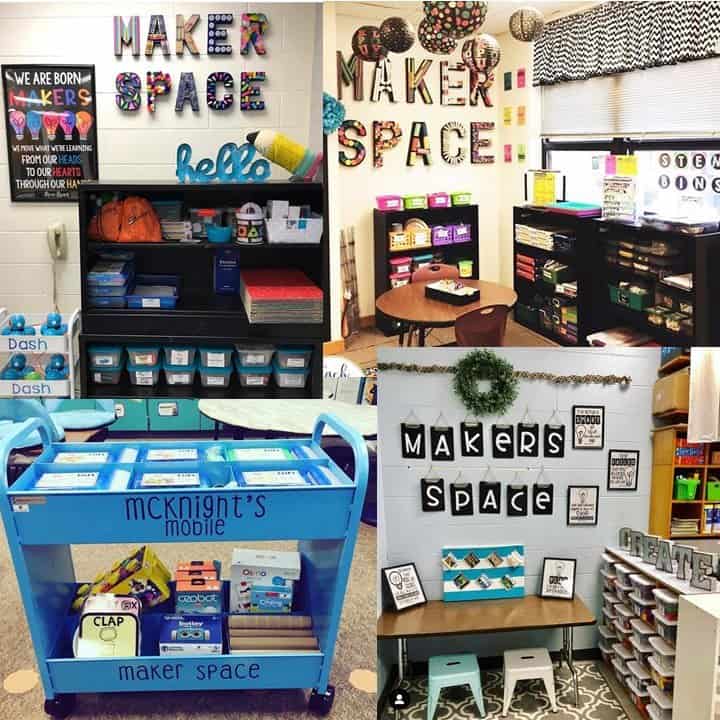
Possible supplies for a Makerspace.
*Cardboard
*empty container
*glue
*bottle caps
*pens/pencils
Taking this into account I found myself wondering how to apply makerspace ideas into preschool and even toddler classrooms. How can I set up a section of our classroom that allows 3-4-year-olds to explore materials in a makerspace like space? I think the key to this is to start with the idea of tinkering. In addition to providing a space to tinker, makerspace would also provide an opportunity for the kids to collaborate with each other to create projects. According to learningchildblog.com if young children have a makerspace there are key responsibilities and roles for the teachers.
- Helping children to problem-solving by asking open-ended questions
- Give plenty of time to design, build, and test
- Help children fix mistakes without taking over their project
Roffey, T. (n.d.). Makerspace for Education. Retrieved February 13, 2020, from http://www.makerspaceforeducation.com
(2017, September 11). Retrieved from https://learningchildblog.com/2017/09/11/makerspaces-in-early-childhood-settings/
Roffey, T., Sverko, C., & Therien, J. (2016, April 3). Makerspace: Curriculum Guide. Retrieved February 13, 2020, from http://www.makerspaceforeducation.com/uploads/4/1/6/4/41640463/makerspace_for_education_curriculum_guide.pdf
According to Makerspace for Education.com, Makerspace is a place where young people have an opportunity to explore their own interests; learn to use tools and materials, both physical and virtual; and develop creative projects" (citation). Makerspace in a classroom can be a section of a room or even a movable cart. Makerspace really focuses on the ideas of constructionism and constructivism coming from the work of Seymour Papert. Constructivism is the theory of learning based on experience and observation. Through experience and reflecting on your experiences individuals construct their own knowledge and understand the world around them. (Roffey).
A makerspace can be as simple or complex as desired. In my research, I found examples of a very complex set up and then ones that were on rolling carts. While each looked physically different they all achieved the same goal. They gave students an opportunity to tinker and build create using their own imagination.
Possible supplies for a Makerspace.
*Cardboard
*empty container
*glue
*bottle caps
*pens/pencils
Taking this into account I found myself wondering how to apply makerspace ideas into preschool and even toddler classrooms. How can I set up a section of our classroom that allows 3-4-year-olds to explore materials in a makerspace like space? I think the key to this is to start with the idea of tinkering. In addition to providing a space to tinker, makerspace would also provide an opportunity for the kids to collaborate with each other to create projects. According to learningchildblog.com if young children have a makerspace there are key responsibilities and roles for the teachers.
- Helping children to problem-solving by asking open-ended questions
- Give plenty of time to design, build, and test
- Help children fix mistakes without taking over their project
Roffey, T. (n.d.). Makerspace for Education. Retrieved February 13, 2020, from http://www.makerspaceforeducation.com
(2017, September 11). Retrieved from https://learningchildblog.com/2017/09/11/makerspaces-in-early-childhood-settings/
Roffey, T., Sverko, C., & Therien, J. (2016, April 3). Makerspace: Curriculum Guide. Retrieved February 13, 2020, from http://www.makerspaceforeducation.com/uploads/4/1/6/4/41640463/makerspace_for_education_curriculum_guide.pdf
Thursday, February 6, 2020
Week 3- Genius Hour
Imagine walking into a classroom that allows students to explore their own passions and encourages creativity what would that look like. How would the classroom function and what would the daily schedule look like?
These are all great questions that you might find yourself asking about Genius Hour. According to GeniusHour.com this pedagogy provides students a choice in what they learn during a set period of time during school. Genius Hour is based on the principle Google uses that focuses on when people work on something that interested them productivity goes up. This same theory can be applied to education.
The same theory Google uses can be applied to education by setting a certain amount of time for students to do a project that interests them. The students then spend several weeks researching the topic and create a final project that is shared with their classmates. Deadlines are limited and creativity is encouraged.
According to Edutopia.org there are six basic tenets of personalized instruction.
1. Dude teacher role- It is important for teachers to monitor students progress of projects to ensure they are staying focused.
2. Learn about your students- Using Genius Hour will allow you to learn more about your students personality and their learning styles.
3. Create a culture of collaboration- Genius Hour allows students the opportunity to work alone or in groups
4. Create an interactive learning environment- Students work to create a presentation to present to the rest of the class.
5. Build flexible pacing, but with structure- Less structure as a teacher which allows students to be more independent
6. Create authentic Assessments- Reflections throughout project.
This video is an example of how Genius Hour is used in a 4th grade classroom.
Carter, N. (2014, August 4). Genius Hour and the 6 Essentials of Personalized Education . Retrieved February 6, 2020, from https://www.edutopia.org/blog/genius-hour-essentials-personalized-education-nichole-carter
Genius Hour- Example of Personalized Learning in Action . (2017, December 17). Retrieved February 6, 2020, from https://www.youtube.com/watch?v=tiy0uzka1ds
What is Genius Hour? . (n.d.). Retrieved February 6, 2020, from http://geniushour.com/what-is-genius-hour/
These are all great questions that you might find yourself asking about Genius Hour. According to GeniusHour.com this pedagogy provides students a choice in what they learn during a set period of time during school. Genius Hour is based on the principle Google uses that focuses on when people work on something that interested them productivity goes up. This same theory can be applied to education.
The same theory Google uses can be applied to education by setting a certain amount of time for students to do a project that interests them. The students then spend several weeks researching the topic and create a final project that is shared with their classmates. Deadlines are limited and creativity is encouraged.
According to Edutopia.org there are six basic tenets of personalized instruction.
1. Dude teacher role- It is important for teachers to monitor students progress of projects to ensure they are staying focused.
2. Learn about your students- Using Genius Hour will allow you to learn more about your students personality and their learning styles.
3. Create a culture of collaboration- Genius Hour allows students the opportunity to work alone or in groups
4. Create an interactive learning environment- Students work to create a presentation to present to the rest of the class.
5. Build flexible pacing, but with structure- Less structure as a teacher which allows students to be more independent
6. Create authentic Assessments- Reflections throughout project.
Carter, N. (2014, August 4). Genius Hour and the 6 Essentials of Personalized Education . Retrieved February 6, 2020, from https://www.edutopia.org/blog/genius-hour-essentials-personalized-education-nichole-carter
Genius Hour- Example of Personalized Learning in Action . (2017, December 17). Retrieved February 6, 2020, from https://www.youtube.com/watch?v=tiy0uzka1ds
What is Genius Hour? . (n.d.). Retrieved February 6, 2020, from http://geniushour.com/what-is-genius-hour/
Thursday, January 30, 2020
Week 2- Opening Learning
Before we dive into this weeks topic I wanted to give a reminder of what open learning is. According to an article on open source.com open education is a "philosophy about the way people should produce, share and build on knowledge." Supporters of open education and learning believe everyone in the world should have access to high-quality education experiences and resources.
In my research I found that I completely agree that the goal of every school should share resources, experiences, curriculum, and lessons with other schools.
In her article about open learning Lauren Landry open pedagogy allows educators to take the concept of openness one step further by engaging students in real work that they can share beyond the classroom. In this article the author suggested that schools transition from assignments that students throw away after they get their grade and assignments that challenge students to create materials that can be shared with the public.
According to Graham there are eight key elements of opening learning:
1. Learning and knowledge rests in diversity of opinions
2. Learning is a process of connecting specialized notes or informations sources
3. Learning my reside in non-human appliances
4. Capacity to know more is critical than what is currently known
5. Nurturing and maintaining connections is needed to facilitate continual learning
6. Ability to see connection between fields, ideas, and concepts is a core skill
7. Currency (accurate, up-to-date knowledge) is the intent of all connectives learning activities; and
8. Decision-making is itself a learning process. Choosing what to learn and the meaning of incoming information is seen through the lens of a shifting reality.
As someone who isn't working in a classroom my experience with open learning varies a little different than my classmates who are teachers in a classroom. For me I have found open learning really valuable. As the director of a child care center with kids aged 6 weeks to 12 years there is a lot to take into account including find developmentally appropriate activities/ curriculum for all our different classrooms.
I found a really great curriculum on Teacher Pay Teacher and have found one of the most useful resources is actually a facebook page of around 63,000 other teachers who use the same curriculum. It has been really useful to post on this facebook page and ask questions and get advice from teachers all across the country who may have more experience.
Here is a really cool video about a school in Eminence KY that operates with an open learning design.
EDhub: Building a 21st Century Space to Transform Learning . (2017, December 7). Retrieved February 6, 2020, from https://www.youtube.com/watch?v=cFyaZtW2iAY
Graham, L., LaBonte, R., Roberts, V., & O'Byrne, I. (n.d.). Open Learning in K-12 Online and Blended Learning Environments.
Landry, L. (2018, May 29). Open Learning: What is it and how can we benefit. Retrieved January 30, 2020, from https://www.northeastern.edu/graduate/blog/what-is-open-learning/
In my research I found that I completely agree that the goal of every school should share resources, experiences, curriculum, and lessons with other schools.
In her article about open learning Lauren Landry open pedagogy allows educators to take the concept of openness one step further by engaging students in real work that they can share beyond the classroom. In this article the author suggested that schools transition from assignments that students throw away after they get their grade and assignments that challenge students to create materials that can be shared with the public.
According to Graham there are eight key elements of opening learning:
1. Learning and knowledge rests in diversity of opinions
2. Learning is a process of connecting specialized notes or informations sources
3. Learning my reside in non-human appliances
4. Capacity to know more is critical than what is currently known
5. Nurturing and maintaining connections is needed to facilitate continual learning
6. Ability to see connection between fields, ideas, and concepts is a core skill
7. Currency (accurate, up-to-date knowledge) is the intent of all connectives learning activities; and
8. Decision-making is itself a learning process. Choosing what to learn and the meaning of incoming information is seen through the lens of a shifting reality.
As someone who isn't working in a classroom my experience with open learning varies a little different than my classmates who are teachers in a classroom. For me I have found open learning really valuable. As the director of a child care center with kids aged 6 weeks to 12 years there is a lot to take into account including find developmentally appropriate activities/ curriculum for all our different classrooms.
I found a really great curriculum on Teacher Pay Teacher and have found one of the most useful resources is actually a facebook page of around 63,000 other teachers who use the same curriculum. It has been really useful to post on this facebook page and ask questions and get advice from teachers all across the country who may have more experience.
Here is a really cool video about a school in Eminence KY that operates with an open learning design.
EDhub: Building a 21st Century Space to Transform Learning . (2017, December 7). Retrieved February 6, 2020, from https://www.youtube.com/watch?v=cFyaZtW2iAY
Graham, L., LaBonte, R., Roberts, V., & O'Byrne, I. (n.d.). Open Learning in K-12 Online and Blended Learning Environments.
Landry, L. (2018, May 29). Open Learning: What is it and how can we benefit. Retrieved January 30, 2020, from https://www.northeastern.edu/graduate/blog/what-is-open-learning/
Thursday, January 23, 2020
Week 1- What are emerging tech?
The biggest thing I learned this week was that emerging technology is not necessary the newest technology. Maybe it is using a simpler piece of technology in a new way. When I first looked at emerging technology I immediately thought about the latest, high tech, and probably expensive piece of technology which initially prevented me from exploring a huge amount of the technology that is available. I am so curious to see what types of new technology students get to explore and use in their classrooms in the coming years.
When I think of emerging technology I always am reminded that when I was a freshman in high school one of my classes was the first in the district to have a Promethean board (smart board). It was so much fun to be able to learn with the teacher how to use it. During my practicum work I remember seeing these boards in every room. It is amazing how such a new technology only a few years ago is now found in every classroom.
I found education escape rooms and 3d printing really interesting. While escape rooms are not new I never thought to use them in the classroom. According to a blog by Lock Paper Scissors by they are really great to use as a way to increase engagement in the classroom. Escape rooms require students to use critical thinking skills to escape and solve a variety of puzzles. They also are a great tool to build team work skills in all age.
When I think of emerging technology I always am reminded that when I was a freshman in high school one of my classes was the first in the district to have a Promethean board (smart board). It was so much fun to be able to learn with the teacher how to use it. During my practicum work I remember seeing these boards in every room. It is amazing how such a new technology only a few years ago is now found in every classroom.
I found education escape rooms and 3d printing really interesting. While escape rooms are not new I never thought to use them in the classroom. According to a blog by Lock Paper Scissors by they are really great to use as a way to increase engagement in the classroom. Escape rooms require students to use critical thinking skills to escape and solve a variety of puzzles. They also are a great tool to build team work skills in all age.
Escape Games: The Boredom-Crushing Classroom Tech you students NEED. . (n.d.). Retrieved January 23, 2020, from https://lockpaperscissors.co/school-escape-games
Saturday, January 18, 2020
Subscribe to:
Comments (Atom)